If you’re planning a new custom home, Palm Beach County building permits are usually the first real test of your schedule. For a new single-family home, getting from first submittal to an issued permit commonly takes a few months. It can take longer when an HOA review, a flood zone, or a coastal approval is involved. That range depends on how complete your plans are, which office reviews them, how many rounds of corrections come back, and whether outside agencies have to sign off. If you’re weighing custom new home construction here, knowing how permitting works will save you weeks of frustration.
This guide covers who issues permits, what the process looks like step by step, which South Florida rules shape your plans, and how to keep your permit moving.
Table of Contents
- Who Issues Building Permits in Palm Beach County?
- Which Projects Need a Palm Beach County Building Permit?
- The Palm Beach County Building Permit Process, Step by Step
- How Long Do Palm Beach County Building Permits Take?
- South Florida Rules That Shape Your Permit
- What Usually Delays a Permit
- How to Keep Your Permit on Track
- Frequently Asked Questions
Palm Beach County Building Division vs. City Building Departments
This is where many homeowners go wrong first. Palm Beach County building permits sounds like one office, but it isn’t.
The County’s Planning, Zoning & Building Department runs a Permit Center. That center processes building permits only for unincorporated Palm Beach County. If your lot sits inside a city or town, that municipality’s building department reviews and issues your permit instead.
That matters right away:
- Delray Beach, Boca Raton, and Boynton Beach each run their own building departments, with their own zoning codes and review boards.
- Smaller coastal towns such as Highland Beach, Gulf Stream, and Ocean Ridge have their own approval processes. Some add design review steps, so check with the town early.
- Unincorporated areas go through the County’s ePZB online portal. The main office is at 2300 N. Jog Road in West Palm Beach, and there’s a South County office on S. Congress Avenue in Delray Beach.
Not sure which one you’re in? Look up the parcel on the Palm Beach County Property Appraiser’s site. It lists the municipality. Two homes a mile apart off Military Trail can fall under completely different rulebooks.
Which Projects Need Palm Beach County Building Permits?

Short respond: almost anything structural, mechanical, electrical, plumbing, or related to the building envelope. For a custom home, you’ll typically see:
- A master building permit for the house itself
- Sub-permits for electrical, plumbing, mechanical (HVAC), and roofing work, plus pool, fence, or driveway work if those are part of the project
- Site-related approvals for drainage, tree removal, or work in the public right-of-way, depending on the jurisdiction
Remodels and additions work the same way. Window and door replacements, roof replacements, and structural changes all need permits because they affect how the house holds up in a storm. If you’re expanding instead of building new, our home additions team goes through the same review process, just with a smaller scope.
Very minor work, like cosmetic finishes, may be exempt. Each jurisdiction keeps its own exemption list, though, so check it before you start.
The Palm Beach County Building Permit Process, Step by Step
Step 1: Confirm Jurisdiction, Zoning, and Flood Zone
Before anyone draws a floor plan, pull the survey and confirm three things: who has jurisdiction, what the zoning allows (setbacks, height, lot coverage), and which FEMA flood zone the lot is in. Each one shapes the design.
Step 2: Clear HOA or Architectural Review (If It Applies)
Many communities in Boca Raton and Delray Beach have HOA architectural committees that must approve your plans before you submit to the city. Some towns and historic districts add a public design review on top of that. Plan for this from day one, because it happens before your permit submittal, not at the same time.
Step 3: Prepare a Complete Permit Set
A typical custom home submittal includes architectural drawings, structural engineering, a site and drainage plan, energy calculations, wind-load design, and product approval numbers for windows, doors, and roofing. Incomplete sets are one of the most common reasons permits stall.
Step 4: Submit and Go Through Plan Review
Plans go to each review discipline: building, structural, electrical, plumbing, mechanical, zoning, and often fire and engineering. Florida law sets maximum review windows for complete applications, though applicants can waive them. In practice, how fast your permit moves depends on whether the reviewers consider your application complete.
Step 5: Respond to Comments
Reviewers send back comments. Your architect and engineer revise the plans and resubmit. One clean round is ideal. Several rounds is where months disappear.
Step 6: Permit Issuance and the Notice of Commencement
Once your plans are approved, the permit is issued. On most custom home and remodel projects, Florida’s lien law requires a recorded Notice of Commencement before the first inspection. You record it with the Clerk of the Circuit Court, and the South County Courthouse on West Atlantic Avenue in Delray Beach offers same-day recording.
Step 7: Inspections Through Final Approval
The permit stays open for the whole build. Inspectors check the work at each stage, from foundation and framing through rough mechanicals, roofing, and final. You can’t move in until the final inspection passes and a certificate of occupancy is issued.
For a broader look at how permitting fits into design and construction, see our walkthrough of the step-by-step process of building a luxury home in South Florida.
How Long Do Palm Beach County Building Permits Take?
There’s no single responses, and anyone who promises an exact date is guessing. The table below shows what each stage usually involves for a new single-family custom home. Your timeline will vary depending on your jurisdiction, how good your plans are, review workload, and whether outside agencies are involved.
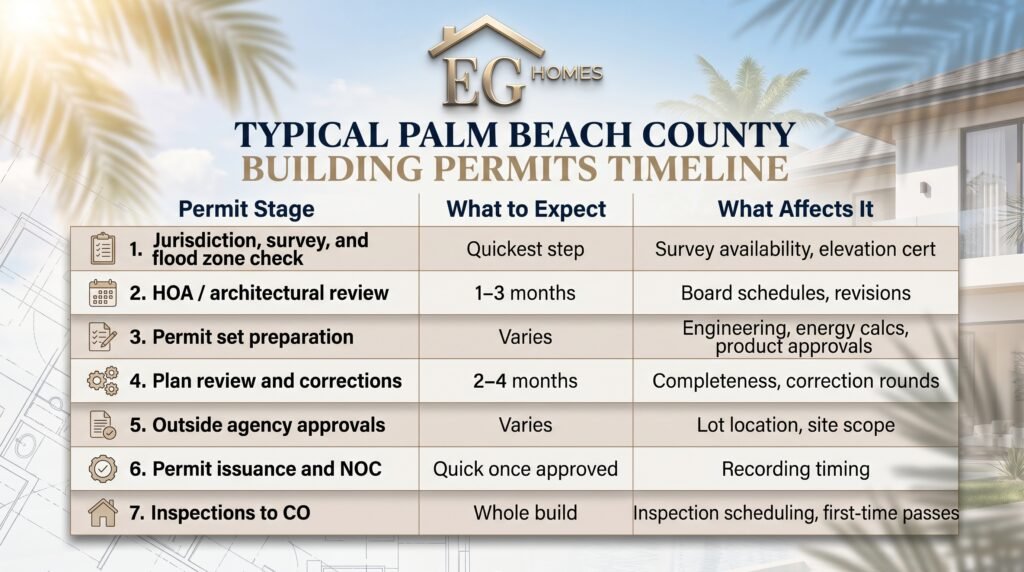
These are general planning ranges, not guarantees. The best way to get a realistic estimate for your lot is to review it with a builder who submits permits in that jurisdiction regularly.
South Florida Rules That Shape Your Permit
The Florida Building Code and the December 31, 2026 Change
Every Palm Beach County building permit is reviewed against the Florida Building Code. The 9th Edition (2026) takes effect statewide on December 31, 2026, replacing the 8th Edition. Which edition governs your project generally depends on when you apply. If you’re submitting plans this winter, ask your builder which edition your design is engineered to. Mixing them up can mean redesigning parts of the plan.
Wind Design and Product Approvals
Palm Beach County isn’t in the High-Velocity Hurricane Zone that covers Miami-Dade and Broward. It still requires high design wind speeds. Windows, doors, garage doors, and roofing must carry a valid Florida Product Approval or an accepted equivalent, and reviewers check those numbers closely. Swapping a window brand mid-project can trigger a plan revision.
Flood Zones and FEMA’s 50% Rule
If your lot is in a Special Flood Hazard Area, your design must meet elevation and flood-resistant construction requirements. For renovations, FEMA’s “substantial improvement” rule applies. If improvements reach 50% or more of the building’s market value, the whole structure must be brought up to current flood standards. This can affect whether an older Delray Beach or Boca Raton home makes more sense to remodel or rebuild.
Coastal Construction
Oceanfront lots along A1A may sit seaward of the state’s Coastal Construction Control Line. Work there needs a separate state coastal permit on top of the local building permit, and that review runs on its own clock.
Planning a custom home in Palm Beach County? Schedule a free consultation with EG Homes Florida to talk through your custom home plans, permit path, and expected construction timeline. Call 561-400-5528 to get started.
What Usually Delays a Permit
Most permit delays come down to a few causes:
- Incomplete submittals. A missing energy calc, an unsigned engineering sheet, or an outdated survey can send an application back before review even starts.
- Multiple correction rounds. Every resubmittal goes back into the review queue.
- HOA timing. If your HOA board meets once a month, a single revision can cost you weeks.
- Product approval mismatches. Products with expired approvals, or ones that don’t match the design wind pressure, will get flagged.
- Unexpected site conditions. Drainage problems or protected trees can turn up after the design is done and force changes.
- Code transitions. Plans drawn to one code edition but submitted after the next one takes effect will need revisions.
Rainy season doesn’t slow plan review. Once work starts, though, wet sites and storm prep can push inspections and field work back.
How to Keep Your Permit on Track
A few habits make a real difference:
- Finalize the design before you submit. Changes after submittal restart parts of the review.
- Hire a builder who knows the specific office. Delray Beach, Boca Raton, and the County each have their own submittal expectations. A home builder in Delray Beach or a luxury home builder in Boca Raton who submits there regularly knows what reviewers look for.
- Answer comments in one complete package. Don’t resubmit piece by piece.
- Record the Notice of Commencement early so it doesn’t hold up your first inspection.
- Keep inspections moving. Under the Florida Building Code, a permit generally stays active as long as it passes an inspection at least every 180 days. If it lapses, you may face renewal steps or have to redo work.
- Think twice about going owner-builder. Florida allows it, but you take on legal responsibility for code compliance. For County permits, you also have to sign the owner-builder affidavit in person.
Frequently Asked Questions
How long does it take to get Palm Beach County building permits for a custom home?
For many new single-family homes, getting from first submittal to an issued permit takes a few months. HOA approvals, coastal permits, and multiple correction rounds can extend that. A complete, well-coordinated plan set is the most reliable way to keep it short.
Do I apply to Palm Beach County or my city for a building permit?
It depends on where your property is. The County handles unincorporated areas, while cities like Delray Beach, Boca Raton, and Boynton Beach issue their own permits. The Property Appraiser’s parcel lookup shows which jurisdiction you’re in.
What is the longest part of the permit process?
It’s usually plan review plus correction rounds, especially for custom homes with complex engineering. For waterfront or HOA-governed lots, outside approvals such as coastal permits or architectural review can take even longer.
Does the new Florida Building Code affect my permit?
It can. The 9th Edition (2026) takes effect December 31, 2026, and which edition applies generally depends on when you submit. Confirm with your builder and designer which edition your plans follow.
Can rainy weather delay my Palm Beach County building permits?
Weather doesn’t affect plan review, but it can delay inspections and the field work they depend on. During South Florida’s rainy season, wet sites and storm prep often push schedules back. Building some slack into your construction schedule helps keep your permit active and your project steady.
Getting Your Permit Right the First Time
Palm Beach County building permits reward preparation. Know your jurisdiction, submit a complete plan set, and plan around the Florida Building Code change on December 31, 2026. If your property is unincorporated, the Palm Beach County Permit Center explains how to apply through ePZB. Current and upcoming code editions are published by the Florida Building Commission. The Palm Beach County Clerk’s Notice of Commencement page covers recording requirements. When you’re ready to build, schedule a free consultation with EG Homes Florida to talk through your custom home plans, permit path, and expected construction timeline. Call 561-400-5528 to get started.