Knowing how to hire a custom home builder in Delray Beach comes down to one habit: verify everything you can before you trust anything you’re told. Look up the state license. Confirm the builder is registered with the city. Get insurance certificates straight from the agent, and visit homes they’ve finished here. Then read the contract for the notices Florida law requires. You’ll work with your custom home builder in Delray Beach through design, permitting, and construction, which often runs well over a year. The checklist below lets you compare candidates side by side before you sign.
The 12-Point Checklist at a Glance
Short on time? Here’s the whole checklist. Each point is explained in detail below.
- Confirm the Florida state license and what it covers
- Check the builder’s registration with the City of Delray Beach
- Get insurance certificates sent directly from the agent
- Search complaints, liens, and permit history
- Visit recently finished homes in Delray Beach
- Test their knowledge of flood zones and wind design
- Ask who handles historic, HOA, and county reviews
- Meet the superintendent who’ll run your site
- Ask how they plan around rainy and hurricane season
- Review the communication and change-order process
- Check the contract for Florida’s required notices
- Get the warranty in writing
Table of Contents
- The 12-Point Checklist at a Glance
- Why Hiring a Custom Home Builder in Delray Beach Takes More Than a Referral
- Steps 1–4: Verify a Delray Beach Builder’s Credentials
- Steps 5–7: Test Local Experience on Your Delray Beach Lot
- Steps 8–10: Questions to Ask a Custom Home Builder About Project Management
- Steps 11–12: Review the Contract and Warranty Before You Hire
- Custom Home Construction Timeline in Delray Beach
- Red Flags When Vetting a Builder in Delray Beach
- Frequently Asked Questions
- Final Thoughts
Why Hiring a Custom Home Builder in Delray Beach Takes More Than a Referral
A neighbor’s recommendation is a good start. It shouldn’t be the whole process. Delray Beach has its own set of building conditions, and a builder who does great work in Wellington or Jupiter may not know them.
Here’s what sets Delray apart:
- Two possible permit offices. The City of Delray Beach Building Division reviews plans, issues permits, and runs inspections inside city limits. Many western Delray addresses, including gated communities like The Bridges and Seven Bridges, sit in unincorporated Palm Beach County and go through the county instead.
- Five local historic districts. Lots in Old School Square, Marina, Del-Ida Park, Nassau Street, or West Settlers face historic preservation review on top of the standard permit.
- Flood zones that change street by street. Waterfront lots in Tropic Isle, homes along the Intracoastal, and the barrier island east of A1A can carry very different FEMA flood designations from homes a few blocks inland. That affects how high your slab must sit.
- Countywide wind-borne debris rules. Palm Beach County falls inside the Florida Building Code’s wind-borne debris region, so every window, door, and garage door needs approved impact protection.
An experienced local builder treats all of this as routine. The 12 steps below show you how to find out whether a candidate really does.
Steps 1–4: Verify a Delray Beach Builder’s Credentials
These four checks take about an hour at your kitchen table. Do them before you spend an afternoon in a sales meeting.
1. Confirm the Florida State License and What It Covers
Ask for the license number and look it up yourself on the Florida Department of Business and Professional Regulation (DBPR) site. A logo in a website footer isn’t proof.
Check three things:
- Status. It should read Current, Active. Anything else needs a clear explanation.
- License type. Certified licenses begin with letters such as CGC (general contractor), CBC (building contractor), or CRC (residential contractor), and they’re valid statewide. A CRC covers residential work, which suits most single-family homes. Larger estates may call for a CBC or CGC.
- Certified or registered. A registered contractor holds a local license that only works in certain jurisdictions. That’s not automatically a problem, but make sure it covers your property.
While you’re there, confirm the license holder (the qualifier) actually works at the company day to day.
2. Check the Builder’s Registration With the City of Delray Beach
Delray Beach requires contractors to register with the city and keep a current license on file before they can submit a permit. The city also expects that record to be updated whenever the license or insurance changes. A builder who works here regularly will already be registered. If the question draws a blank look, they probably haven’t pulled many permits in town.
3. Get Insurance Certificates Sent Directly From the Agent
Ask the builder’s insurance agent to email certificates of insurance to you. Don’t accept a PDF forwarded by the builder. You’re looking for:
- General liability, which covers damage to your property or a neighbor’s during construction.
- Workers’ compensation or a valid exemption. Florida construction employers generally must carry it even with a single employee. Without it, an injury on your lot can become your problem.
Note the expiration dates, too. A policy that lapses mid-build needs a renewal plan.
4. Search Complaints, Liens, and Permit History
- DBPR license lookup. The same record shows any public disciplinary action.
- Palm Beach County Clerk official records. Search the company name for recorded liens and lawsuits. One old supplier dispute isn’t a deal-breaker. A pattern is.
- Permit records. The city’s permit portal and the county’s permit search show which projects the builder actually permitted. If someone claims a dozen local homes and you can’t find the permits, ask why.
Steps 5–7: Test Local Experience on Your Delray Beach Lot
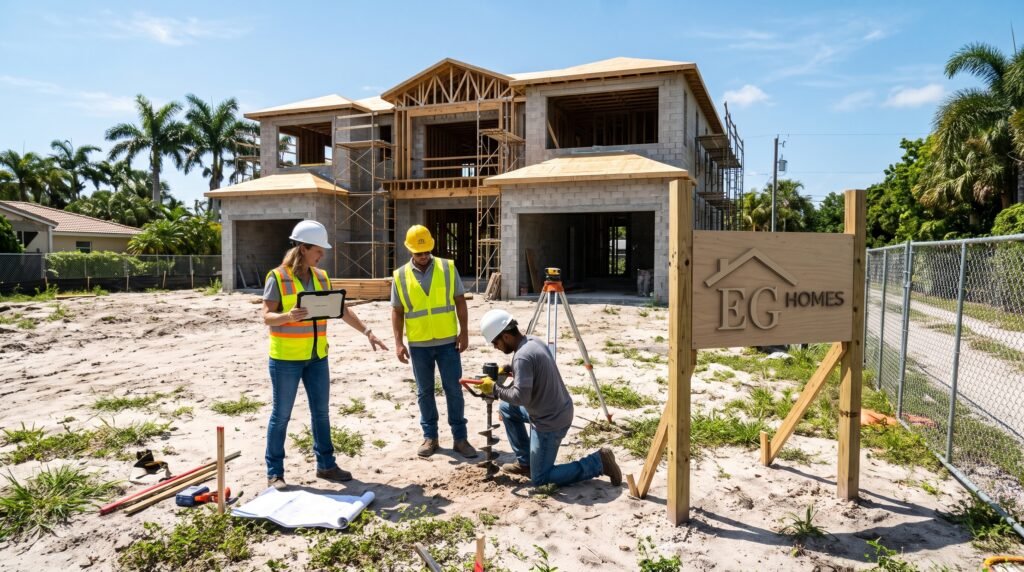
A license means a builder is allowed to build. Local experience tells you whether they’ve already solved the problems your lot is going to raise.
5. Visit Recently Finished Homes in Delray Beach
Ask for two or three homes completed in the last few years, ideally in neighborhoods like yours. A waterfront lot in Tropic Isle has different challenges than an older street in Lake Ida or a beach cottage lot off South Ocean Boulevard. Then talk with the owners without the builder present:
- Did the builder raise problems before you found them?
- How were change orders priced and documented?
- What came up after move-in, and how quickly was it fixed?
Also ask whether the builder handles remodels and additions. A firm that does both can tell you honestly whether a ground-up build is the right move, or whether home additions in Palm Beach County would get you most of the way there.
6. Test Their Knowledge of Flood Zones and Wind Design
Give the builder your lot address and ask what they’d expect. Someone who builds here often should speak comfortably about:
- How your FEMA flood zone sets the finished-floor elevation, and when the elevation certificate gets done.
- Impact-rated windows and doors, including the difference between Florida Product Approval and a Miami-Dade Notice of Acceptance.
- Roof-to-wall connections and how trusses are tied down against uplift.
- Drainage on a lot raised higher than the homes next door.
You don’t need to know the right respond. Just notice whether they explain things clearly or brush the question off.
7. Ask Who Handles Historic, HOA, and County Reviews
Historic district review, HOA architectural approval in gated communities like Seven Bridges, and county review for unincorporated lots each add steps before construction starts. Ask who prepares those submittals and how they’re built into the schedule. Our guide to the step-by-step process of building a custom home in South Florida shows how design, approvals, and construction fit together.
Comparing lots in more than one city? Each one sets its own procedures. A builder who works across the area, for example as a luxury home builder in Boca Raton as well as in Delray, should be able to explain the differences without guessing.
Want a second opinion on your lot? Schedule a free consultation with EG Homes Florida to discuss your custom home building plans and the construction timeline you can realistically expect. Request your free consultation.
Steps 8–10: Questions to Ask a Custom Home Builder About Project Management
Most custom home headaches come from day-to-day management, not structural failures. These questions show you what the next year or more will feel like.
8. Meet the Superintendent Who’ll Run Your Site
The person who sells you the job often isn’t the one on your lot each week. Ask to meet the project manager or superintendent. Find out how many homes they’re running at once and how often they’ll be on site. A great superintendent spread across too many jobs still misses inspections.
9. Ask How They Plan Around Rainy and Hurricane Season
South Florida’s rainy season runs roughly from late May into October, and hurricane season officially runs June 1 through November 30. A single afternoon storm can wash out a concrete pour or a roofing day. Ask:
- Which phases they try to finish before the wettest months.
- How they protect open framing and stored materials ahead of a storm.
- What their hurricane-prep plan is for an active site, and who secures it.
Builders who’ve worked several seasons in Delray give specific answers. Vague ones usually mean they’ll improvise on your schedule.
10. Review the Communication and Change-Order Process
Ask to see a sample schedule and a sample change order. A well-run builder can show you:
- How often you’ll get updates, and in what form: a client portal, weekly meetings, site photos.
- How a change gets priced, approved in writing, and added to the schedule before work begins.
- Who you call when something on site looks wrong.
If changes get approved with a handshake in the driveway, expect disputes at the end.
Steps 11–12: Review the Contract and Warranty Before You Hire
This is where vetting turns into protection. Have a Florida construction attorney review the final contract. Use these two steps to spot problems before it gets there.
11. Check the Contract for Florida’s Required Notices
Florida residential construction contracts must include certain statutory language, and a generic or out-of-state template may leave it out. Look for:
- The Construction Lien Law notice, which explains that unpaid subcontractors and suppliers can lien your property even if you’ve paid the builder.
- The Florida Homeowners’ Construction Recovery Fund notice, which describes a possible recovery option if a licensed contractor violates certain Florida laws.
- The Chapter 558 notice, which sets out the notice-and-cure process for construction defect claims.
Also confirm the builder will provide lien releases from subcontractors and suppliers as payments go out, plus a Contractor’s Final Payment Affidavit before final payment. A Notice of Commencement should be recorded with the county before work begins.
12. Get the Warranty in Writing
Ask what the warranty covers, for how long, and how to file a claim. Workmanship, major systems, and structural items are often covered on different terms. Confirm that manufacturer warranties on windows, roofing, and equipment are registered in your name. Then ask the homeowners from Step 5 how warranty calls were actually handled.
Custom Home Construction Timeline in Delray Beach
A builder worth hiring gives you a phase-by-phase schedule before you sign and explains what might stretch it. The ranges below are general planning estimates for a ground-up custom home in South Florida, not guarantees. Design complexity, lot conditions, permit review, weather, and inspection scheduling all shift them, and several phases overlap.
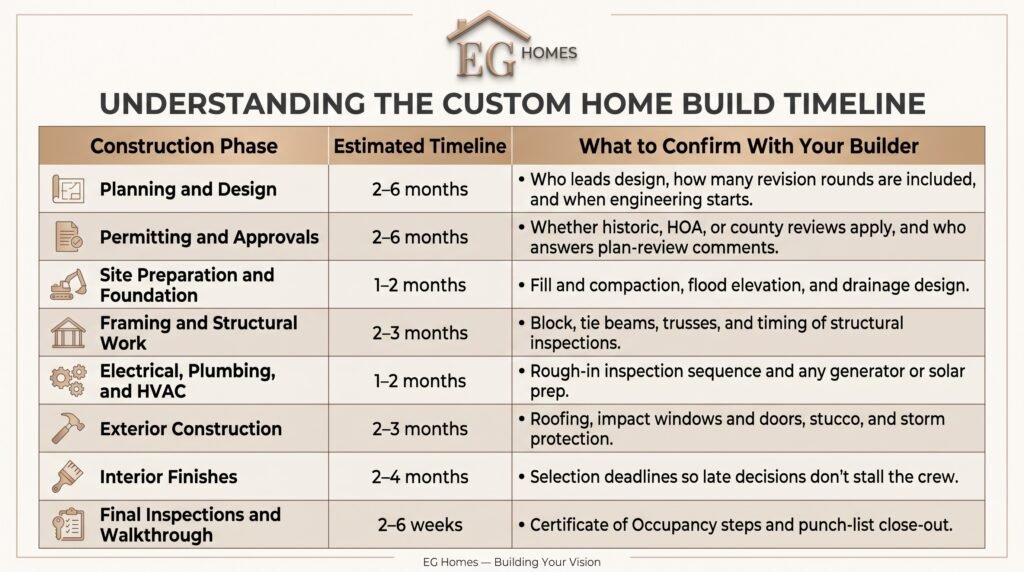
If a builder’s total timeline sounds far shorter than this with no explanation, ask how they got there.
Red Flags When Vetting a Builder in Delray Beach
Some responses tell you all you need to know:
- They suggest you pull the permit yourself as an “owner-builder.”
- They want a large deposit before there’s a signed contract or a permit application.
- Insurance certificates come from the builder instead of the agent, or never arrive.
- They can’t point to a recent Delray Beach home you can drive past.
- Schedule questions get answered with don’t worry about it.
Walking away early is far easier than replacing a builder halfway through framing.
Frequently Asked Questions
How do I verify a custom home builder’s license in Delray Beach?
Search the builder’s name or license number on the Florida DBPR license lookup at MyFloridaLicense.com, or use the DBPR mobile app. Confirm the license is active and covers residential construction. Then make sure the builder is registered with the City of Delray Beach, which the city requires before a permit can be submitted.
What’s the difference between a certified and a registered contractor in Florida?
A certified contractor passed the state exam and can work anywhere in Florida. A registered contractor holds a local license that’s only valid in specific jurisdictions. If you’re hiring a custom home builder in Delray Beach who’s registered rather than certified, confirm the license covers your property’s location.
How many builders should I interview before hiring one?
Three serious candidates is a good number for most homeowners. It’s enough to compare how each handles your lot, schedule, and contract without dragging the search out for months. Run every candidate through the same 12-point checklist so the comparison is fair.
What should be in a custom home builder’s contract in Florida?
Look for the Construction Lien Law notice, the Florida Homeowners’ Construction Recovery Fund notice, and the Chapter 558 construction defect notice. A solid contract also spells out the payment schedule, change-order process, lien releases, and warranty terms. Before you hire a custom home builder in Delray Beach, have a Florida construction attorney review the final draft.
How do I get started with EG Homes Florida?
Start with a free consultation. Bring your lot address, any survey you have, and a rough idea of what you want to build. We’ll walk through your goals, the approvals your lot may need, and a realistic construction timeline. You’re welcome to run us through this same 12-point checklist, including our written workmanship warranty.
Final Thoughts
Hiring the right builder comes down to checking what can be checked and listening closely to how candidates talk about the hard parts. Before you sign anything, confirm the builder’s license and complaint history with the Florida Department of Business and Professional Regulation. Review the City of Delray Beach Building Division’s permit requirements, including its contractor registration rule. Then read the Florida Homeowners’ Construction Recovery Fund statute so you know which disclosures belong in your contract. When you’re ready, schedule a free consultation with EG Homes Florida to discuss your custom home building plans and expected construction timeline.