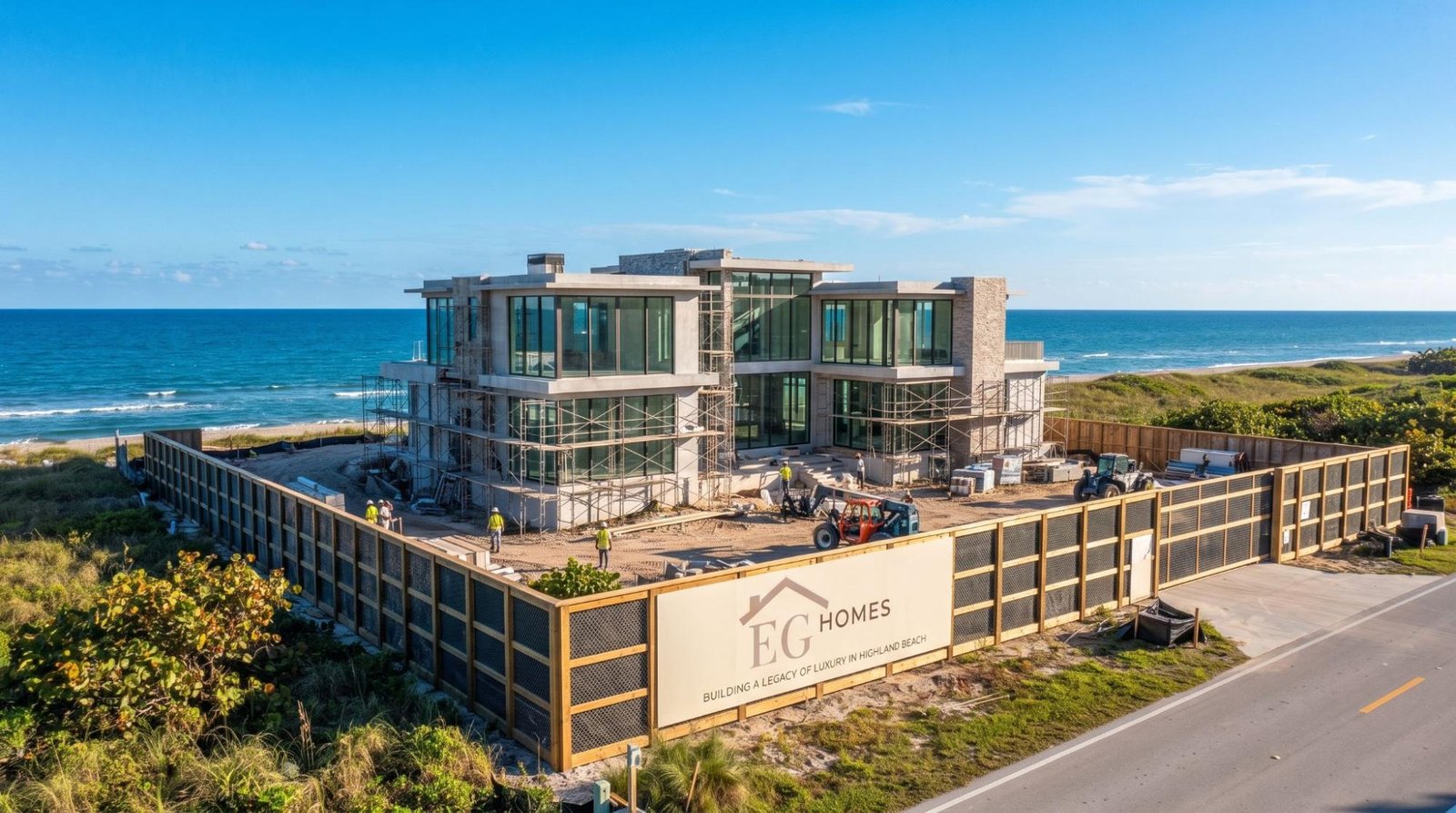
Building a home on the sand in Highland Beach isn’t the same as building three miles inland. The rules change. The materials change. The engineering changes. And if you’re planning oceanfront home construction in Highland Beach, you’re going to run into questions most inland builders have never had to answer. Working with an experienced Palm Beach County home builder who understands the coastal side of the county isn’t a nice-to-have. It’s the whole ballgame.
Highland Beach is a narrow strip of land tucked between Boca Raton and Delray Beach, hugging State Road A1A with the Atlantic on one side and the Intracoastal on the other. Roughly three miles long, zoned mostly for low-density residential, and packed with some of the most valuable dirt in Palm Beach County. Building here is a privilege. It’s also a technical challenge that catches a lot of homeowners off guard.
Here’s what actually makes oceanfront work different, and what you need to know before you break ground.
The Highland Beach Coastline Isn’t Like Anywhere Else in Palm Beach County
Highland Beach sits inside zip code 33487, sandwiched between the Boca Inlet to the south and the Delray Beach city line to the north. A1A runs the full length of town, and most oceanfront lots sit on the east side of that road with direct Atlantic frontage. The rest are Intracoastal, tucked into pockets like Bel Lido Isle and Byrd Beach.
What that means for your build: you’re dealing with a barrier island environment. Salt spray is constant. Wind loads are higher than they’d be even a mile inland. The water table sits close to the surface. And every square foot of your lot is governed by state, county, and town-level regulations that all layer on top of each other.
If you’re comparing quotes from custom home builders in Boca Raton or Delray who’ve mostly built west of I-95, ask them how many oceanfront jobs they’ve actually completed. It’s a fair question, and the answer tells you a lot.
Hurricane-Proof Homes Start with the Foundation
You’ll hear the phrase hurricane-proof homes thrown around a lot in Florida marketing. The honest version: no home is truly hurricane-proof. But hurricane-resistant design, done right, gets you close enough that your home stays standing when the neighbor’s doesn’t.
For oceanfront construction, that starts underground. Deep pilings driven to load-bearing soil are standard on the sand. Elevated first-floor slabs meet FEMA base flood elevation requirements, which in most of Highland Beach means building well above grade. Reinforced concrete tie-columns run from foundation to roof, tying the whole structure together as one continuous load path.
Above the slab, the design details compound: impact-rated windows and doors, reinforced roof-to-wall connections, and roof systems engineered for wind uplift ratings that can handle Category 5 gusts. Well-designed hurricane-proof home designs also factor in secondary threats like storm surge, wind-driven rain, and debris impact. It’s not one silver bullet. It’s about twenty details working together.
Homeowners looking into hurricane-proof homes in Florida often assume the requirements are the same statewide. They aren’t. Coastal high-hazard zones (V-zones and Coastal A-zones) carry stricter standards than inland lots, and Highland Beach is squarely in that zone.
Coastal Codes, Setbacks, and the A1A Factor
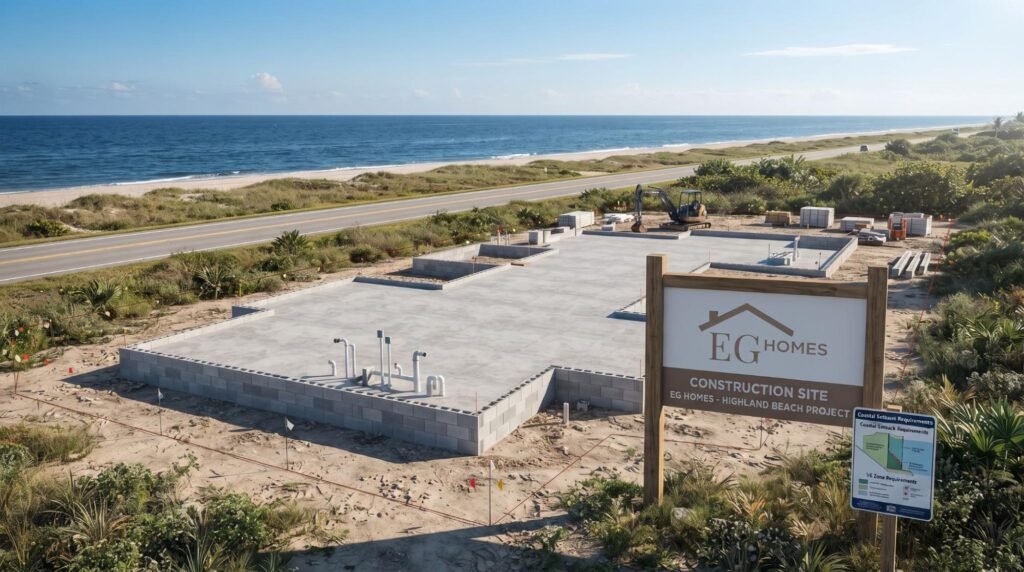
The Florida Building Code has a separate section for High-Velocity Hurricane Zones and coastal construction, and Palm Beach County adds its own layer. Then Highland Beach’s town code piles on setback rules, height restrictions, and lot coverage limits.
A few things that trip up first-time oceanfront builders:
- Coastal Construction Control Line (CCCL): Any work seaward of Florida’s CCCL requires a state permit through the Department of Environmental Protection. This is separate from your local building permit and adds real time to your schedule.
- Dune protection: You can’t just bulldoze what’s on your beach. Native dune vegetation is protected, and disturbing it triggers additional review.
- A1A frontage rules: Your front setback, driveway placement, and even mailbox location have to work with the FDOT right-of-way along State Road A1A.
None of this is a reason not to build. It’s a reason to plan carefully with a builder who’s already been through it. Some clients also expand an existing beachfront property instead of tearing down and starting over, in which case our home additions team handles the structural upgrades and code compliance side by side.
Materials That Survive Salt Air, Sun, and Storms
Salt eats metal. UV cooks finishes. Humidity swells wood. On the ocean, standard-grade materials fail faster than they would even in Boca Raton or Boynton Beach.
Here’s what tends to hold up on Highland Beach waterfront homes:
Stainless steel fasteners (grade 316, not the cheaper 304) for anything structural. Cementitious siding or true stucco over concrete block instead of vinyl. Aluminum, fiberglass, or PVC trim in place of wood. Copper or aluminum flashing. Impact glass with a laminated interlayer. And roofing systems (standing seam metal or concrete tile) rated for coastal exposure.
The upfront cost is higher. The lifetime cost is lower, because you’re not replacing corroded hardware or rotted trim every five years. Any high-end home builder in FL working on the ocean will price these upgrades in from day one. If a quote skips them, that’s a red flag.
What Highland Beach Waterfront Homes Cost to Build
Cost questions get asked first and answered last, because the honest answer is: it depends. But here’s a realistic frame.
Oceanfront custom construction in Highland Beach typically runs well above the county average per square foot. The premium reflects deep pilings, impact-rated openings, elevated slabs, coastal-grade materials, and the extended permitting timeline. Land cost is a separate conversation entirely.
For context, custom home builders in Miami, Florida quote similar coastal premiums on Miami Beach and Sunny Isles work. The Palm Beach coast isn’t cheaper. If anything, the smaller pool of qualified oceanfront-experienced builders in this stretch of the county can push labor costs up during peak season.
Ask any luxury home builder in Palm Beach for an allowance-based estimate early, then refine as your finishes, fixtures, and site plan lock in. Fixed-price contracts on oceanfront work rarely stay fixed if the scope is still fuzzy.
Choosing the Right Builder for Oceanfront Work
Not every custom home builder in Boca Raton or Delray has real oceanfront experience. When you interview builders, get specific:
- How many oceanfront or seaward-of-CCCL projects have you completed?
- Who handles your state DEP permitting?
- What’s your standard piling design for this soil profile?
- Can I tour a completed project and talk to the homeowner?
A builder who’s confident on the coast will answer these without hesitation. One who dodges them is telling you something. This is also where the difference between a general contractor and an experienced luxury home builder in Palm Beach County shows up; coastal work rewards specialists.
If you’re still weighing your options, our home addition and remodel guide covers a few related considerations for expanding an existing coastal property instead of starting fresh.
Timeline Expectations for Oceanfront Projects
Inland custom homes in Palm Beach County can go from design to keys in roughly 12 to 18 months. Oceanfront builds routinely stretch to 18 to 30 months. The extra time isn’t inefficiency. It’s real work:
- Additional survey and geotechnical study (add 4–8 weeks)
- State CCCL permitting (add 3–6 months on top of local permits)
- Deep piling installation and inspection
- Longer material lead times on impact-rated openings and specialty coastal products
- Weather delays during hurricane season
Build the timeline into your expectations from the start. Rushing an oceanfront job is where corners get cut, and corners cut on the sand come back to hurt you later.
Ready to Start Your Highland Beach Build?
Highland Beach oceanfront construction is a specialty, not a side gig. If you’re planning a custom build, a full teardown-and-rebuild, or a major structural addition on the water, you want a team that lives in this work.
We’d be glad to walk your lot, review your plans, and give you a straight answer on scope, timeline, and budget. Get in touch here to start the conversation.
For homeowners wanting to dig deeper into the technical side of coastal construction, the Florida Building Commission’s coastal construction resources publish updated code requirements and hurricane design standards worth bookmarking.
FAQ
What makes a home hurricane-proof in Florida?
Hurricane-resistant homes combine reinforced foundations, impact-rated windows and doors, and a continuous load path from roof to slab. In oceanfront zones like Highland Beach, elevated slabs and deep pilings are also required.
How much does it cost to build a hurricane-proof home in Florida?
Coastal hurricane-resistant construction runs at a premium over inland builds due to pilings, impact glass, and elevated slabs. A detailed quote from an oceanfront builder is the only reliable number for your specific lot.
How long does oceanfront home construction take in Highland Beach?
Most Highland Beach oceanfront builds take 18 to 30 months from design through completion. State CCCL permits, deep foundation work, and longer material lead times add to the timeline versus inland projects.
Do I need special permits to build on A1A in Highland Beach?
Yes. Oceanfront lots seaward of the state’s Coastal Construction Control Line require permitting through the Florida Department of Environmental Protection, on top of standard town and county permits.
Who are the best custom home builders in Boca Raton and Highland Beach for oceanfront work?
Look for builders with documented oceanfront project history, FDEP permitting experience, and references you can call. EG Homes serves Highland Beach and the Palm Beach coast; reach out through our contact page to schedule a consultation.