A new home in Highland Beach must meet several layers of rules at once. Any Highland Beach custom home builder must meet the town’s building department and zoning code, the Florida Building Code’s wind and flood rules, a state coastal permit for work near the beach, and the town’s sea turtle lighting standards. The big change this year is Ordinance 2026-003, which rewrote how the town treats oceanfront construction. If you’re weighing a custom home builder in Highland Beach, here’s what each layer means for your plans.
Table of contents
- Why Highland Beach is different from the mainland
- The 2026 change: Ordinance 2026-003 and the CCCL
- State coastal permits a Highland Beach custom home builder must secure
- Flood zone and wind requirements
- Sea turtle lighting rules
- Town permits, zoning and job-site rules
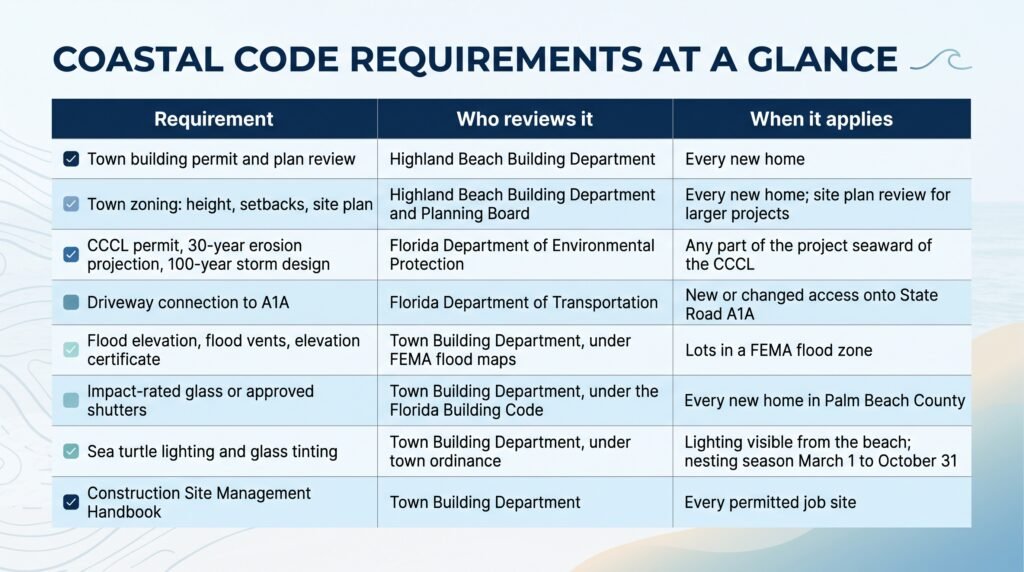
- Coastal code requirements at a glance
- Frequently asked questions
- Your next step
Why Highland Beach Is Different From the Mainland
Highland Beach sits on a narrow barrier island between Boca Raton and Delray Beach, with the Atlantic on one side and the Intracoastal Waterway on the other. State Road A1A, called South Ocean Boulevard here, runs the length of the town. That means almost every lot is either oceanfront, Intracoastal-front, or a short walk from both.
Location drives everything else. Oceanfront lots east of A1A fall under the state’s coastal construction rules. Lots on either side deal with flood zones. And the town’s roughly three-mile beach is a busy sea turtle nesting ground, which shapes how you light a house that faces it.
The town also runs its own Building Department rather than relying on Palm Beach County. Plans are reviewed and inspected locally, and the same department handles permits for home builds in neighboring Gulf Stream under an interlocal agreement.
The 2026 Change: Ordinance 2026-003 and the Coastal Construction Control Line
The Coastal Construction Control Line (CCCL) is a boundary the State of Florida sets along sandy beaches. Seaward of it, construction needs extra review from the Florida Department of Environmental Protection (FDEP), because that zone takes the brunt of storm surge and erosion.
In 2026, the town’s Building Department found that a decades-old section of Highland Beach’s seawall code banned any part of a structure east of the CCCL. The town hadn’t been enforcing it. For decades, it had relied on FDEP’s permit process instead, and the state does allow construction seaward of the line when a project meets its siting and design rules.
The Town Commission adopted Ordinance 2026-003 on October 20, 2026. It removes the conflicting prohibition and defers to the state’s CCCL permit, while still requiring full compliance with town zoning, the Florida Building Code, and floodplain rules. Two related topics were held back for a separate ordinance with more public input: the lowest living floor elevation and construction near the dune.
For an oceanfront owner, that means two things. First, an FDEP-permitted design east of the line is no longer blocked by a town clause on paper. Second, more rule changes are coming, so your design should be checked against the current town code right before you submit.
What About the Oceanfront Setback?
In June 2026, town officials also flagged a zoning provision requiring a 120-foot setback from a beachfront lot’s vegetation line or eastern property line, reduced to 50 feet where a seawall exists. On many lots, a 120-foot setback would push the house toward A1A. The town’s zoning code also says the ocean setback is determined by FDEP under the CCCL rules. Ask your builder to confirm with the Building Department which setback governs your lot before design gets far along.
State Coastal Permits a Highland Beach Custom Home Builder Must Secure
If any part of your project sits seaward of the CCCL, you’ll need an FDEP CCCL permit in addition to your town building permit. A few things decide what you can build:
- The 30-year erosion projection. FDEP estimates where the seasonal high-water line will be in 30 years. Single-family homes seaward of that projection face stricter criteria, and where a substantial seawall exists, the projection generally stops at the wall.
- Storm design. Habitable structures that extend seaward of the CCCL must be designed to resist the forces of a 100-year storm event.
- What goes under the house. Substantial walls aren’t allowed below the first finished floor of habitable structures seaward of the CCCL. That’s why oceanfront homes here usually sit on pilings or columns, with breakaway walls or open space below.
- Pools and excavation. Pools must be designed to minimize permanent excavation seaward of the line, and sand dug up there generally has to stay on site.
Because A1A is a state road, a new driveway connection may also need an access permit from the Florida Department of Transportation. Your builder should coordinate all three agencies so one approval doesn’t force a redesign for another.
Flood Zone and Wind Requirements
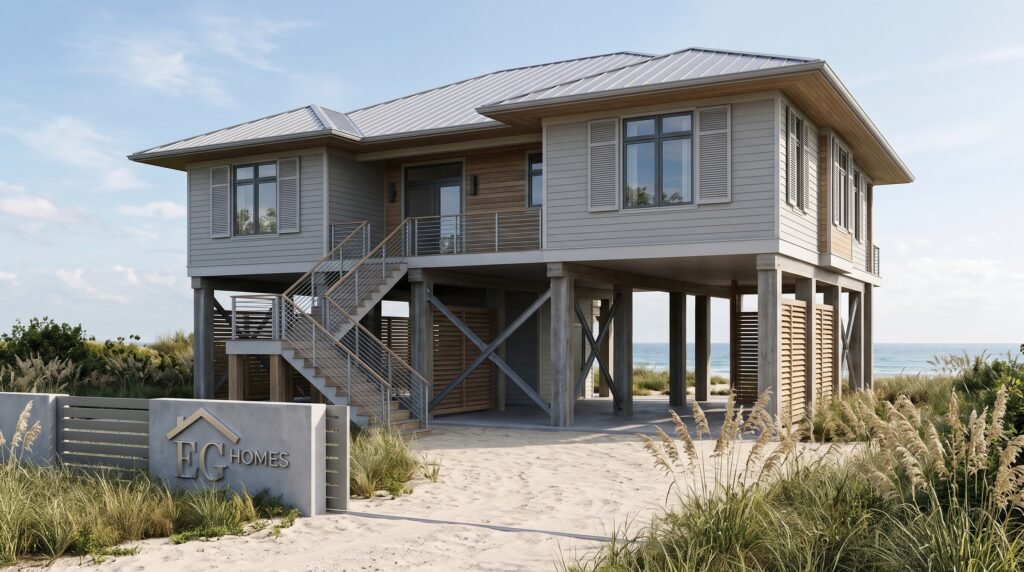
Many Highland Beach lots fall within FEMA flood zones, so check yours on FEMA’s flood map early. Your lowest floor must meet the required flood elevation, and you’ll need an elevation certificate as the house goes up. Expect flood vents and breakaway or open construction below the living floor on many lots, especially on the ocean side.
Wind is the other constant. All of Palm Beach County falls within the Florida Building Code’s wind-borne debris region, so every glazed opening needs impact-rated glass or approved storm shutters. Palm Beach County isn’t part of the High-Velocity Hurricane Zone that applies to Miami-Dade and Broward, but oceanfront lots are usually designed for higher wind exposure than inland sites.
The code is also changing. Florida’s 9th Edition Building Code takes effect statewide on December 31, 2026. In general, the edition in force when your permit application is submitted is the one you build to. Highland Beach has also adopted its own local amendments to the current code, so a plan that passes elsewhere won’t automatically pass here. Our Boca Raton building codes guide covers the wind and impact-window rules in more detail.
Planning a custom home in Highland Beach? Schedule a free consultation with EG Homes Florida to talk through your lot, your plans, and the approvals your build will need.
Sea Turtle Lighting Rules
This rule is easy to overlook if you’re new to building on the coast. According to the town, Highland Beach records more sea turtle nests each year than Boca Raton or Delray Beach, and nesting season runs from March 1 to October 31.
During that season, no artificial light may shine on the nesting beach from dusk to dawn. The town’s updated lighting ordinance is based on the state’s model lighting ordinance for sea turtle protection. For a new home, that affects:
- Exterior fixtures facing the beach, which generally need to be shielded, downward-directed, and long-wavelength (amber or red)
- Ocean-facing glass, which may need tinting to limit light spilling onto the beach
- Pool, landscape and walkway lighting near the dune
The rules reach the job site, too. The town’s lighting standards also cover temporary construction lighting near the beach during nesting season. Planning fixtures and glass with this in mind early avoids a costly change late in the project.
Town Permits, Zoning and Job-Site Rules
The Highland Beach Building Department accepts Palm Beach County’s Universal Permit Application and takes submittals online through its permit portal. Larger projects may also need a development order and site plan review, and lots in single-family zoning must meet the town’s height and setback limits.
Two practical points matter on a small barrier island. First, the town publishes a Construction Site Management Handbook that contractors must sign, and violations can lead to a stop-work order. Second, neighbors are close, and A1A is the main road through town, so deliveries, parking, and noise all need a plan. Good new home construction planning builds those rules into the schedule from day one.
Frequently Asked Questions
Can I build east of the CCCL in Highland Beach?
Yes. Ordinance 2026-003, adopted October 20, 2026, defers to the state’s FDEP CCCL permit, but your project still has to meet town zoning, flood, and building code rules.
Does a Highland Beach custom home builder need a state permit?
If any part of the project sits seaward of the CCCL, yes. You’ll need an FDEP CCCL permit in addition to the town building permit.
Is Highland Beach in the High-Velocity Hurricane Zone?
No. The HVHZ covers Miami-Dade and Broward, but Highland Beach is in the wind-borne debris region, so openings still need impact glass or shutters.
When are sea turtle lighting rules in effect?
Nesting season runs March 1 to October 31. Beach-facing lights must stay off the nesting beach from dusk to dawn.
How do I start planning a custom home in Highland Beach?
Start with a survey and a builder who knows the town’s process. EG Homes Florida offers a free consultation to review your lot and the approvals it will need.
Your Next Step
These rules come from sources you can check. The Town of Highland Beach CCCL ordinance page explains why the town rewrote its oceanfront rules and what still applies. The Florida Department of Environmental Protection’s CCCL Program regulates construction seaward of the control line to protect beaches, dunes, and neighboring properties. The town’s sea turtle page confirms the March 1 to October 31 nesting season. When you’re ready to plan your build, schedule a free consultation with EG Homes Florida to talk through your lot, your plans, and the approvals your build will need.