Most custom homes in South Florida take 12 to 18 months from the first design meeting to move-in. Construction itself usually takes 8 to 12 months of that.
If you’re trying to figure out how long to build a house in South Florida, the honest answer is that it depends on a handful of things. Design complexity matters, along with permit turnaround time, what’s under the lot, subcontractor scheduling, rainy-season weather, and how quickly inspections get booked. Our new home construction services cover every one of these phases, and below we break down how long each one typically takes.
Custom Home Building Timeline in South Florida at a Glance
A custom home isn’t built in one long push. It moves through a series of phases, and most of them have to pass inspection before the next can start. That’s why the overall timeline usually surprises people.
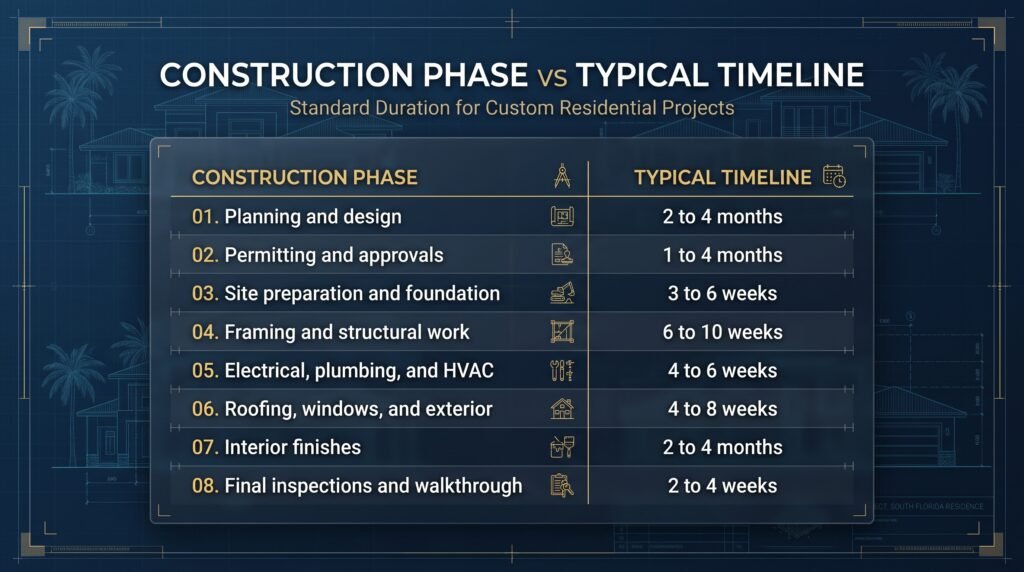
Planning and Design: 2 to 4 Months
This is the phase you control most directly, and it sets the pace for everything after it.
What Happens During Design
You’ll work with an architect or designer on the floor plan, elevations, and style. A structural engineer then designs the foundation, wall reinforcement, and roof connections to meet Florida’s wind-load requirements. Depending on the lot, you may also need a boundary survey, a soil test, and a drainage plan.
Why Design Time Varies
Some families sign off on drawings within a couple of months. Others go through several rounds of revisions, and that’s fine. Changing a line on paper is far faster than moving a wall later. Every decision you lock in now, like window sizes, ceiling heights, and kitchen layout, saves time during construction.
If your lot is in an HOA or a gated community, plan for architectural review too. Many review boards in Boca Raton and Delray Beach meet only once a month, so a single round of comments can add several weeks.
Permitting and Approvals in South Florida: 1 to 4 Months
Permitting frustrates homeowners most, mainly because it’s out of their hands.
Who Reviews Your Plans
South Florida has a patchwork of building departments. Delray Beach, Boca Raton, and Boynton Beach each review plans through their own city building divisions. Unincorporated areas go through the Palm Beach County Building Division. Each department has its own queue, submission rules, and turnaround times.
Plans are usually reviewed by several disciplines, including zoning, structural, electrical, plumbing, and mechanical. If any reviewer leaves comments, your team revises and resubmits, and that discipline’s review starts over.
South Florida Building Requirements That Affect Timing
- Wind-load design: plans must show how the structure resists high design wind speeds under the Florida Building Code.
- Product approvals: windows, doors, and roofing need Florida Product Approval, or a Miami-Dade NOA in some cases.
- Flood zones: many coastal lots sit in flood zones shown on the FEMA Flood Map Service Center, which affects the required floor elevation and the paperwork.
- Coastal construction: oceanfront lots seaward of the Coastal Construction Control Line may also need state review, which can add significant time.
Inland lots often clear permitting in one to three months. Coastal properties and busy departments can take longer. If you’re building in Delray, our home builder in Delray Beach page explains what local homeowners should expect.
Site Preparation and Foundation: 3 to 6 Weeks
Once the permit is issued and the Notice of Commencement is recorded, work begins on the ground.
The crew clears the lot, removes any existing structure, and brings in fill to reach the required elevation. Because of South Florida’s high water table and sandy soil, compaction testing is common. Next come the underground plumbing, termite treatment, rebar, and the slab pour, with an inspection at each step.
Rain has the biggest impact here. You can’t pour concrete in a downpour, and a soaked site needs time to dry. For a closer look at each step, read our foundation construction process guide.
Framing and Structural Work: 6 to 10 Weeks
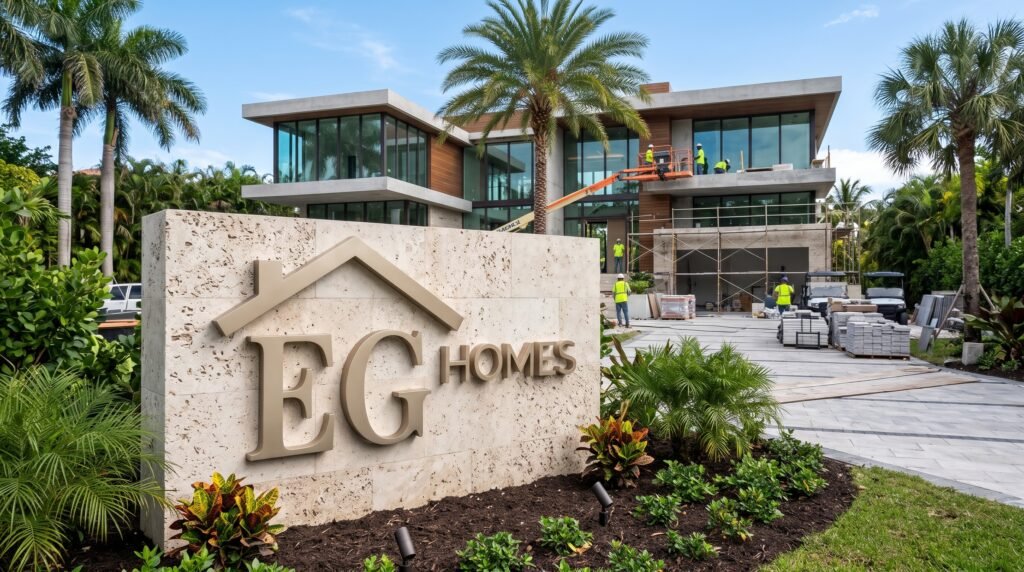
This is when the house starts to look like a house.
Most South Florida homes use concrete block (CBS) construction. Masons lay the block walls, steel reinforcement runs through grout-filled cells, and a poured concrete tie beam caps the walls. The tie beam is central to hurricane resistance and gets its own inspection.
Roof trusses are then set, strapped down, and sheathed. Trusses are engineered and built off-site, so ordering them early keeps the schedule moving. Two-story homes take longer because the second floor adds another tie beam and more inspections. Our framing stage guide covers this phase in more detail.
Electrical, Plumbing, and HVAC: 4 to 6 Weeks
With the shell built, the trades move inside for rough-in. That means running wiring, supply and drain lines, ductwork, and low-voltage cabling for internet, security, and smart home features.
Each trade’s rough-in has to pass inspection, followed by the insulation inspection, before drywall can go up. Coordinating three or four trades in the same space takes careful scheduling, because one crew falling behind can hold up everyone else.
Planning Your Custom Home?
Every lot and design comes with its own schedule. Schedule a free consultation with EG Homes Florida to talk through your plans and get a realistic picture of your construction timeline.
Roofing, Windows, and Exterior Finishes: 4 to 8 Weeks
This phase dries in the house, so interior work can move forward without weather getting in.
Roofing: Underlayment goes on first to protect the home while tile or metal roofing is on order. Both can have long lead times, so lock in those selections early.
Impact windows and doors: These are a core part of hurricane-resistant construction and are often made to fit your openings. They’re one of the most common causes of schedule gaps, so a good builder orders them as soon as the openings are confirmed.
Stucco: Stucco goes on in layers, and each coat needs time to cure. Exterior paint, soffits, gutters, and hardscape follow.
Interior Finishes: 2 to 4 Months
This is usually the longest construction phase. It covers drywall, trim, cabinetry, countertops, tile, flooring, paint, fixtures, and appliances.
Custom cabinetry, natural stone, and specialty tile take extra time because they’re measured and made for your home. Countertops, for example, can’t be templated until the cabinets are installed. Changing a finish at this stage is the fastest way to add weeks to the schedule.
Final Inspections and Move-In: 2 to 4 Weeks
Each discipline does a final inspection. In flood zones, an elevation certificate is usually required too. Once everything passes, the building department issues a Certificate of Occupancy, which means you can legally live in the home.
Before move-in, you’ll do a walkthrough with your builder and make a punch list of small fixes like paint touch-ups or cabinet adjustments. Most of these get handled within a couple of weeks.
What Can Delay a Custom Home Construction Project?
Even with a solid plan, a few things can stretch how long it takes to build a house in South Florida:
- Weather: The rainy season runs roughly from late spring through fall, and hurricane season runs from June 1 to November 30. Storms can shut job sites down for days.
- Permit revisions: Each round of plan review comments adds time.
- Inspection scheduling: In busy periods, a day or two of waiting between inspections adds up.
- Material lead times: Impact windows, roof tile, trusses, and custom cabinets are common bottlenecks.
- Site conditions: Poor soil or drainage problems may require extra fill or engineering.
- Mid-build design changes: These can trigger revised drawings or a permit revision.
How to Keep Your Custom Home Project on Schedule

You can’t control the weather, but you have more influence than you might think:
- Make your selections early. Ideally, choose windows, roofing, cabinets, and fixtures during design.
- Finalize the plans before you submit them. Fewer changes mean fewer permit revisions.
- Hire a builder who knows local building departments. That knowledge helps avoid the most common review comments.
- Answer questions quickly. A decision that sits for a week can push back several trades.
- Start site work in the drier months when you can. Early phases tend to move faster without daily storms.
Plan Your Build With a Realistic Timeline
Every new home in South Florida must meet the Florida Building Code, which the Florida Building Commission develops and updates on a regular cycle. Working with a builder who keeps up with current requirements is one of the best ways to keep your schedule on track. When you’re ready to plan your build, schedule a free consultation with EG Homes Florida at (561) 400-5528 to talk through your custom home plans and expected construction timeline.
Frequently Asked Questions
How long does it take to build a house in South Florida?
Most custom homes take 12 to 18 months from design to move-in, with 8 to 12 months of active construction.
What is the longest phase of building a custom home?
Interior finishes usually take the longest during construction, often 2 to 4 months. Design and permitting combined can take just as long.
How long do building permits take in South Florida?
Many inland residential permits take one to three months. Coastal lots, HOA reviews, and plan revisions can add more time.
Does rainy season delay home construction in Florida?
Yes. Heavy rain can stop concrete pours, roofing, and stucco work, and hurricane season can close job sites for several days.
When can I move into my new home?
You can move in once you receive the Certificate of Occupancy and finish your final walkthrough, usually 2 to 4 weeks after construction wraps up.